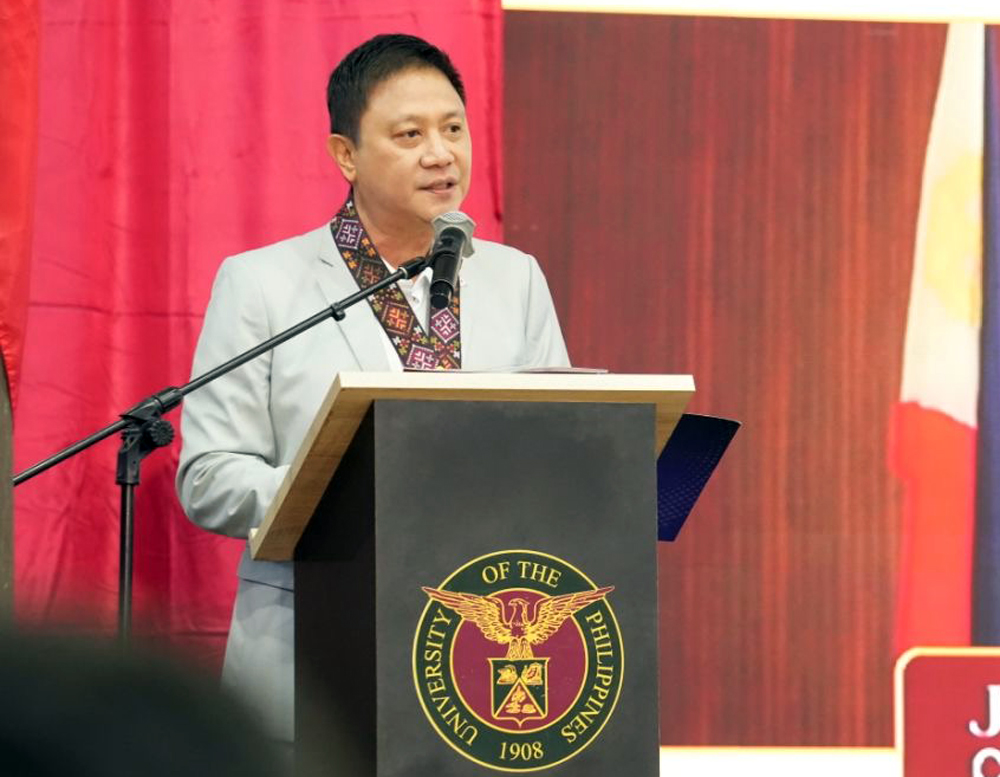
Philippine Sports Commission (PSC) Chairman Patrick Gregorio has laid out an ambitious vision that could redefine the future of Philippine sports, proposing the establishment of the country’s first-ever Sports University under the University of the Philippines (UP) System.
Gregorio unveiled the proposal during his commencement address to the graduating class of the UP College of Human Kinetics at the Varsity Training Center, where he challenged one of the country’s premier academic institutions to take the lead in transforming sports into a powerful platform for education, innovation, economic growth, and nation-building.
Addressing the graduates, Gregorio shared what he described as a long-term dream not only for the University of the Philippines but for the entire Philippine sports landscape.
OKBET is Asia’s most trusted and popular online sports gaming platform. Visit us on OKBET to stay up to date with all sports news from around the world.
“My dream for Philippine sports is to build a proud nation. To this end, my dream for UP is to build a Sports University. A university that produces not only champions, but the coaches, scientists, educators, entrepreneurs, administrators, and innovators who make those champions possible,” Gregorio said.
The proposal envisions a specialized institution that goes beyond producing elite athletes. Instead, it seeks to develop the entire ecosystem that supports sporting excellence by training future coaches, sports scientists, physical educators, sports psychologists, nutritionists, performance analysts, administrators, researchers, and entrepreneurs who can help elevate Philippine sports to international standards.
Gregorio emphasized that sustained success in sports cannot rely solely on the talent of athletes. Rather, it requires a strong academic and scientific foundation supported by world-class education, research, and innovation. Through a dedicated Sports University, he believes the Philippines can create a sustainable pipeline of professionals capable of strengthening every level of the country’s sporting structure—from grassroots development to elite competition.
To underscore the feasibility of his proposal, Gregorio pointed to several countries that have long invested in specialized sports universities as integral components of their national sports programs.
Among the institutions he cited were Germany’s Deutsche Sporthochschule Köln (German Sport University Cologne), China’s Beijing Sport University, Russia’s Lesgaft National State University of Physical Education, Sport and Health, and Japan’s Nippon Sport Science University (NSSU). These universities have become globally recognized centers for sports science, coaching education, athletic performance, research, and sports management, producing generations of Olympians, coaches, and industry leaders.
LOOK: San Juan City Mayor Francis Zamora, Navotas City Mayor John Rey Tiangco, and Philippine Sports Commission Chairperson Patrick Gregorio are among those in attendance at the PhilSports Arena watch party as fans rally behind Pinay tennis star Alex Eala vs Paolini| @ABSCBNNews pic.twitter.com/Py4AroJ8Bj
— Ganiel Krishnan (@KrishnanGaniel) July 6, 2026
Closer to home, Gregorio also noted that neighboring Southeast Asian countries have already embraced similar models. Thailand operates the Thailand National Sports University (TNSU), while Vietnam has established the Vietnam National University of Physical Education and Sports (VNUPES), both serving as national hubs for athlete development and sports education.
By highlighting these examples, Gregorio stressed that the Philippines has an opportunity to join a growing list of nations that recognize sports as a strategic investment rather than merely a recreational pursuit.
According to the PSC chairman, the proposed Sports University would generate benefits that extend far beyond the playing field. It would strengthen athlete development programs, professionalize coaching and sports education, promote research in sports science and medicine, encourage innovation in sports technology, and create new career opportunities within the rapidly growing sports industry.
Gregorio also believes that the institution could serve as a catalyst for economic activity by supporting sports entrepreneurship, facility management, event organization, sports tourism, and related industries, ultimately positioning sports as a significant contributor to national development.
Beyond medals and championships, he emphasized the role of sports in shaping national identity, inspiring the youth, and building stronger communities.
Closing his message to the graduates, Gregorio challenged them to use their education to make a lasting impact on Philippine society, reminding them that their responsibility extends well beyond the classroom.
“Gawin mong masaya ang atleta, magtatagumpay ang mga Pilipino. Your diploma is not the finish line. It is your starting block. Go where you are needed. Build athletes. Build communities. Build industries. Para sa kabataan at para sa bayan,” he added.
The proposal comes at a time when the Philippines continues to seek ways to build on recent international sporting successes and strengthen its long-term sports development program.
While still in the conceptual stage, Gregorio’s vision of a UP-based Sports University presents a bold blueprint for institutionalizing excellence in Philippine sports—one that aims to produce not only world-class athletes but also the coaches, educators, scientists, and leaders who will shape the future of the nation’s sporting landscape for generations to come.
 Don’t miss out on the latest sports news, updates, and fan discussions!
 Follow our Facebook page Sports PH News today and join the community of passionate sports fans.
Leave a Reply